Why AI Companies Are Racing to Own the Full Stack (And What It Means for Enterprise Buyers)
The AI industry is undergoing a profound shift in how companies approach infrastructure. What once looked like a clear separation, model developers renting compute from cloud providers, is collapsing into vertical…
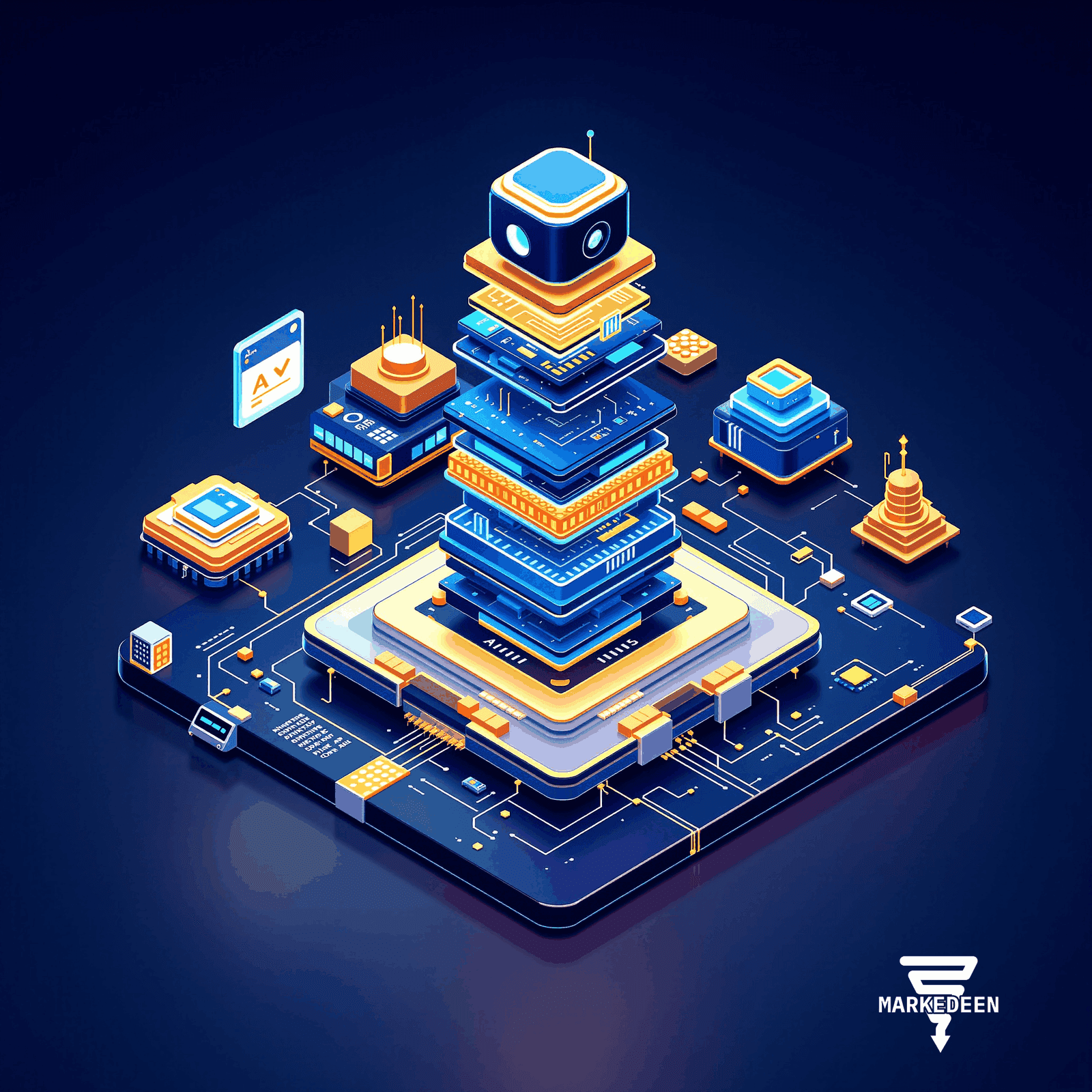
The AI industry is undergoing a profound shift in how companies approach infrastructure. What once looked like a clear separation, model developers renting compute from cloud providers, is collapsing into vertical integration. OpenAI is designing its own inference chips. Google has split its TPU architecture into separate training and inference variants. Anthropic is leasing entire GPU clusters and controlling data center operations. Microsoft is replacing third-party models with in-house alternatives in products like Excel and Outlook. The pattern is unmistakable: AI companies that once rented infrastructure now want to own silicon, networking, power, and facilities. This isn't just cost optimization. It's about controlling the entire value chain from electrons to embeddings.
Why the Full-Stack Shift Is Happening Now
The move toward vertical integration stems from three converging forces: economics, optimization, and strategic control.
First, cost. Training and serving frontier models at scale is extraordinarily expensive. OpenAI announced its Jalapeño chip, developed with Broadcom in roughly nine months, as part of a broader strategy to make compute "more abundant, resulting in AI which is faster, more reliable, more affordable, and more accessible." When you're serving billions of inference requests, even modest efficiency gains translate to massive savings. Owning the silicon means you can optimize every layer of the stack for your specific workloads rather than adapting to general-purpose hardware.
Second, performance. Google introduced TPU 8t for training and TPU 8i for inference at Cloud Next 2026, splitting its custom silicon strategy for the first time. This specialization allows each chip to be tuned for its task, training chips prioritize throughput and memory bandwidth, while inference chips optimize for latency and power efficiency.
Third, supply and control. When compute is the fundamental constraint on your ability to train the next model generation, you don't want to be at the mercy of allocation decisions made by third parties. Owning or controlling infrastructure means you control your roadmap.
What This Means for Enterprise Buyers: A New Procurement Calculus
For enterprises evaluating AI platforms, this shift introduces a new set of tradeoffs that didn't exist two years ago.
The calculus is no longer just "which model is best?" It's "which model provider has the infrastructure strategy that aligns with our risk tolerance and timeline?"
How Vertical Integration Changes Vendor Risk
Traditional vendor risk assessments focused on financial stability, contract terms, and feature completeness. The full-stack shift adds new dimensions:
Supply chain concentration. When your AI provider also owns the chip design, data center operations, and power infrastructure, a disruption at any layer can cascade. But the flip side is also true, providers with integrated stacks may be more resilient to external shocks because they're less dependent on third-party allocations.
Strategic alignment. A provider building its own chips is signaling a long-term commitment to the space. That commitment can be reassuring, but it also means they're making massive capital bets that will influence product priorities for years. If your use case doesn't align with their optimization targets, you may find yourself on the wrong side of that bet.
Lock-in depth. It's one thing to be locked into a model API. It's another to be locked into a provider's entire infrastructure stack. Migration costs increase when your workloads are optimized for specialized hardware or deeply integrated tooling.
The Marketing and Procurement Implications
Marketing systems and procurement frameworks built for SaaS or cloud services don't fully account for this new reality. Here's what needs updating:
Longer evaluation cycles. You're not just evaluating a model, you're evaluating an infrastructure philosophy. Does the vendor's chip roadmap align with your scaling timeline? If they're building for training efficiency and you need inference at the edge, that's a mismatch that will compound.
Scenario planning for vendor consolidation. The partner you choose today may control far more of your AI supply chain in 18 months. Microsoft replacing OpenAI and Anthropic models with its own MAI models in Excel and Outlook is a case study in how quickly this can shift.
Why This Matters Beyond the Hype
The shift to vertical integration isn't just an industry inside-baseball story. It fundamentally changes the economics, the risk profile, and the strategic leverage in AI deployments. For enterprises, it means the vendor selection process is no longer just about which model performs best on your benchmark. It's about which infrastructure philosophy aligns with your scaling timeline, your risk tolerance, and your negotiating position two years from now.
We've been watching this pattern intensify over the past six months, and it's becoming harder to ignore: the companies that control the full stack, from silicon to model weights, are consolidating power in ways that will reshape enterprise AI for the next decade. The question for buyers isn't whether to engage with this new reality. It's how to engage strategically, with eyes open to both the opportunities and the constraints that come with it.
Sources
- Techzine (2026) *Google presents TPU 8t and TPU 8i chips; splits training and inference*. Available at: https://www.techzine.eu/blogs/infrastructure/140680/google-presents-tpu-8t-and-tpu-8i-chips-splits-training-and-inference/ (Accessed: 17 August 2026). Confirms that the eighth-generation split into TPU 8t for training and TPU 8i for inference is the first time Google has purpose-built separate chips for each. Both are built on TSMC's 2nm process and were announced at Cloud Next 2026 for availability in late 2027, so the split is announced rather than shipping.
More on Strategy
Want a system like this in your business?
We build the automation behind everything you just read.