Self-Healing Business Systems: When Automation Rewrites Its Own Playbook
Agentic workflows are transforming how businesses automate—systems that diagnose, fix, and improve themselves without human intervention. Here's what that means for your operations.
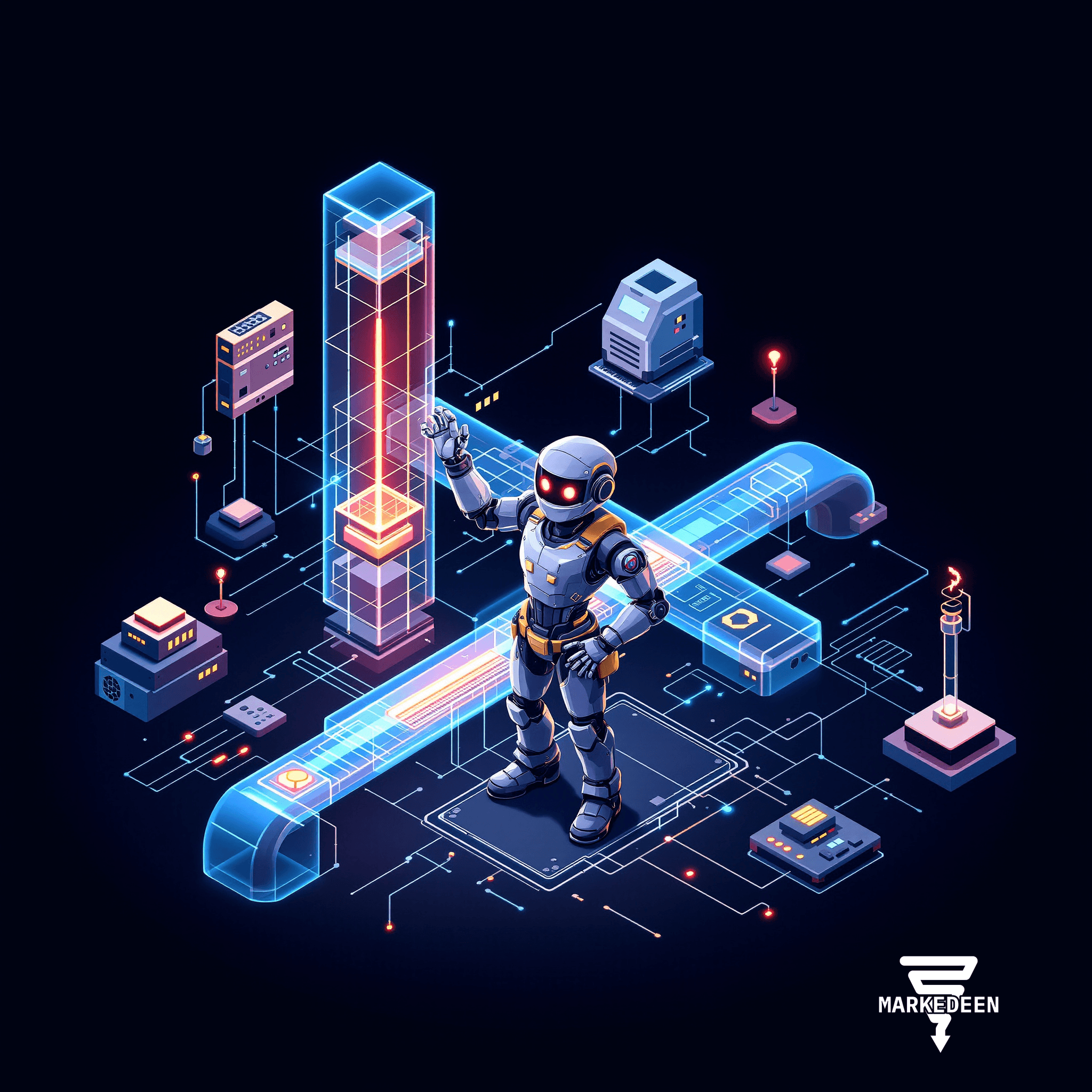
At Markedeen, we've been watching a fundamental shift in how businesses think about automation. For years, the conversation has been about building workflows, mapping every step, handling every edge case, maintaining every integration. But something more interesting is emerging: systems that don't just execute tasks, but solve problems.
The difference is profound. Traditional automation asks: "How do we do this?" The new generation asks: "What needs to happen?"
The Hidden Cost of Brittle Systems
Most businesses underestimate how much time they lose to automation maintenance. You build a lead generation workflow, deploy it, and three weeks later it breaks because a website changed its structure. Or an API endpoint gets deprecated. Or a data format shifts slightly.
The real cost isn't the initial build. It's the ongoing babysitting. Every broken workflow means someone stops what they're doing, digs through logs, identifies the failure point, and patches the system. Multiply that across dozens of automations and you've created a second full-time job just keeping the lights on.
We've seen companies where 30-40% of engineering time goes to maintaining existing automations rather than building new capabilities. That's not a technology problem. It's an architecture problem.
When Systems Learn to Self-Correct
Agentic workflows operate on a different principle: goal-oriented execution with built-in resilience. Instead of following a rigid script, these systems understand what outcome you need and dynamically determine how to achieve it.
Here's what that looks like in practice. A traditional scraping workflow might have 15 nodes: fetch page, parse HTML, extract fields, handle pagination, format data, export to spreadsheet. If the website's HTML structure changes, the entire workflow breaks.
An agentic approach says: "Get me 200 sales job listings from this source, filtered by region, in a spreadsheet." The system figures out how to navigate the site, recognizes when its initial approach fails, tries alternative methods, and updates its own process documentation for next time.
The difference is the system has agency, the ability to reason about problems and adapt its behavior without human intervention.
From Step-by-Step to Outcome-Driven
This shift changes what's possible at a business level. We're seeing three immediate applications:
Dynamic Lead Generation: Instead of building separate workflows for LinkedIn, company directories, and industry databases, you describe your ideal customer profile and let the system determine the best sources and extraction methods. When one source dries up or changes, the system pivots automatically.
Adaptive Data Processing: A client recently needed to consolidate vendor information from 50+ different sources, each with unique formats. Rather than building 50 parsers, their system learned the pattern: identify the vendor, extract contact details, standardize the output. When a new vendor source appeared, it required no additional configuration.
Self-Documenting Operations: Every time an agentic system solves a problem, it can record the solution as a reusable pattern. This creates an organizational knowledge base that grows more capable with use. Your automation doesn't just work, it gets smarter.
The Architecture Behind Resilience
What makes this possible isn't a single tool, but a different way of structuring systems. We work with a three-layer framework:
Workflows define the what, the outcome you need and the constraints that matter. These are written in plain language, not code. "Scrape job listings, filter by criteria, output to spreadsheet."
Agents provide the reasoning layer. They interpret the workflow, assess available tools, and make decisions about execution strategy. When something fails, they diagnose the issue and attempt alternative approaches.
Tools are the actual integrations, APIs, scrapers, data processors. The agent selects which tools to use and how to combine them based on the situation.
This separation means failures are contained and addressable. A tool can break without bringing down the entire operation. The agent simply tries a different approach.
The Business Case for Adaptability
The efficiency gains are measurable. We've tracked projects where agentic approaches delivered working solutions 5-10x faster than traditional builds. But the bigger value is in reduced maintenance overhead.
One client was spending roughly 15 hours per week maintaining data collection workflows across six different sources. After migrating to an agentic architecture, maintenance time dropped to less than 2 hours, mostly reviewing outputs rather than fixing broken processes.
Another saw their automation coverage expand from 12 processes to 47 in the same timeframe, simply because building new capabilities no longer required extensive technical configuration.
The ROI isn't just speed. It's the ability to scale automation across your organization without scaling your automation team proportionally.
What This Means for Your Operations
If you're evaluating where to invest in automation, consider the maintenance burden. Systems that require constant hands-on management create technical debt that compounds over time. Systems that adapt and self-correct become organizational assets that appreciate.
The question isn't whether to automate. It's whether your automation architecture can evolve as fast as your business needs to.
At Markedeen, we help businesses design these adaptive systems, not as experimental projects, but as production infrastructure that handles real operational load. The goal isn't to eliminate human oversight, but to elevate it from fixing broken pipes to directing strategic capability.
If your team is spending more time maintaining automations than building new ones, it's worth examining whether your architecture is working for you or against you. The next generation of business systems doesn't just execute, it thinks.
More on Automation
Want a system like this in your business?
We build the automation behind everything you just read.